


Skincare
6 Benefits Of Mineral Sunscreen
Payal Bhattacharya
We all know that the best line of defence against the sun is using sunscreen. It protects our skin cells from the harmful UV rays of the sun and can prevent tanning, sunburn and inflamed skin. Additionally, this protection also ensures that our skin is free of radical damage caused due to excess sun exposure thereby preventing fine lines, aging, dark spots and hyperpigmentation. So technically, sunscreens can be effective in taking care of most of our skin woes if not all and these umpteenth benefits of sunscreen is the reason why you should always put on SPF before leaving your home. But did you know that based on their composition and defence mechanisms, there are different types of sunscreens available? Let’s take a closer look at this.
Types Of Sunscreen
Essentially, sunscreens work towards protecting our skin from the harmful rays of the sun- both UVA and UVB. UVA rays are longer in wavelength and can cause long term effects like skin cancer and ageing. On the other hand, UVB rays only reach the surface of your skin and can cause issues like sunburn or tanning. Based on the defence mechanism in preventing both the UV rays from penetrating our skin, the types of sunscreens are:
1. Mineral Sunscreen:
The sunscreen sits on the surface of the skin and reflects all the UV rays thereby preventing them from entering the skin and causing damage.
2. Chemical Sunscreen:
The sunscreen is absorbed into the skin and the chemicals in the sunscreen convert the UV rays absorbed into the skin into heat that is dissipated from the skin.
Therefore, at first glance it may seem like chemical sunscreen can be more effective in curbing the long term effects of excess sun exposure, however, chemical sunscreens are widely unpopular due to the kinds of chemicals used in them which are indirectly absorbed into the skin. As a result, most chemical sunscreens can be risky and it is just better to apply a mineral sunscreen in its place.
Benefits Of Mineral Sunscreen:
Here are 6 compelling reasons why you need to make the smooth and hassle-free shift to mineral sunscreens to make your sunny days better.
1. Provides Protection:
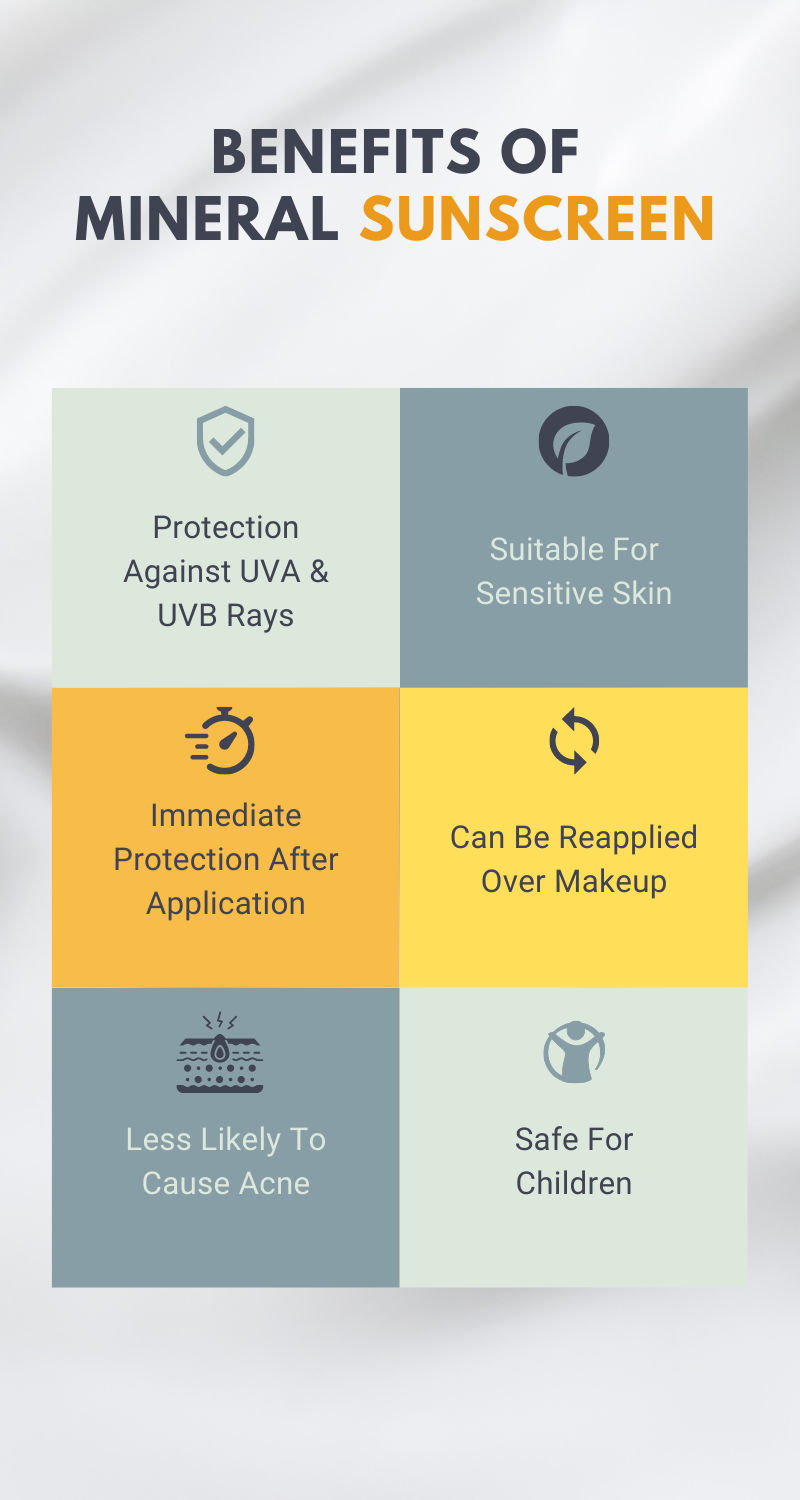
The full spectrum of ultraviolet radiation consists of both UVA and UVB rays meaning that these two rays are strong enough to penetrate clouds and glass and have a photoageing effect on our skin causing ageing signs like age spots, fine lines and wrinkles. However, a mineral sunscreen with both Titanium dioxide and Zinc oxide protects well against these rays. So the next time you are picking up a bottle or tube of sunscreen look for the words “broad spectrum” or “full spectrum” to know that the product screens both UVA and UVB radiation.
2. For Sensitive Skin:
Since mineral sunscreens are not directly absorbed into the skin like chemical sunscreens, instead they just sit on the surface of the skin, they are less likely to cause irritation to sensitive skin. Chemical sunscreen, on the other hand, photo-allergic contact dermatitis because the ingredients penetrate the skin and can cause issues. As a result, people with sensitive skin should opt for mineral sunscreen since it is generally well tolerated by them.
3. Immediate Protection:
In order for chemical sunscreen to work, one has to wait till they are properly absorbed by the deeper layers of the skin so that the UV rays are demolished properly. However, that doesn’t happen to be the case with mineral sunscreens at all. Since this sunscreen only reflects rays by remaining on the skin's surface one doesn’t have to wait for it to get absorbed thereby providing immediate protection against the sun.
4. Can Be Reapplied:
In order for them to work effectively, sunscreen needs to be reapplied every 3-4 hours which can be [pretty problematic if you are in the middle of the day with a face full of makeup. But it’s okay when you have mineral sunscreen for reapplication because it can even be applied over your foundation without ruining your flawless makeup face.
5.Less Likely To Cause Acne:
Many people tend to avoid sunscreen because they fear this might aggravate their acne. And there is a strong basis to this fact. Chemical sunscreens are known to get absorbed into the skin and can cause worsen breakouts while mineral sunscreens can cause clogged pores. But due to evolution in the cosmetic industry, mineral sunscreens have found a way to protect acne prone skin types too. Simply search for mineral sunscreens with the word “non-comedogenic” (medical term for “clogged pores”) and you can easily use sunscreen.
6. Safe For Children:
Owing to the fact that there are no harmful chemicals being pulled into the deeper layers of the skin and because it simply sits atop the skin’s surface screening UV rays, mineral sunscreens are extremely safe for children. The sunscreen only acts like a physical barrier between your skin and the sun’s rays without involving your body fluids in the process, making it absolutely safe and useful for kids.
Mineral sunscreen benefits our skin in ways that affect the long term look of it and helps in maintaining the health of our skin. Therefore, the next time you are wondering of the one product you should definitely add in your makeup pouch, add a mineral sunscreen and be fearless even on those bright sunny days.
Read More:
- Difference Between Mineral & Chemical Based Sunscreen
- Interesting Sunscreen Facts you should know
- 10 Best Mineral Sunscreens in India: Face & Body | Purplle
Latest Articles






About Payal Bhattacharya
Payal is an editor at Purplle.com. She believes that the world will be a much better place if everyone owns a cat, it’s bizarre but true. She’s very sensitive and particular about her skincare routines and never skips it even for a single day. She loves to read about intimate hygiene and educate herself about female and male personal care which clearly reflects in her writings.