PurplleBlog HomeBest Spf 50 Sunscreen Under ₹500 In India: Top Picks For Humid Indian Weather
Best SPF 50 Sunscreen Under ₹500 in India: Top Picks for Humid Indian Weather
Written by Ananya Rao, Purplle Beauty Editor (5 years in skincare journalism, 400+ products tested)
Medically reviewed by Dr. Rohit Menon, MBBS, MD (Dermatology), DDVL
Last updated: 9 September 2026Reading time: 17 minutes
The Quick Answer
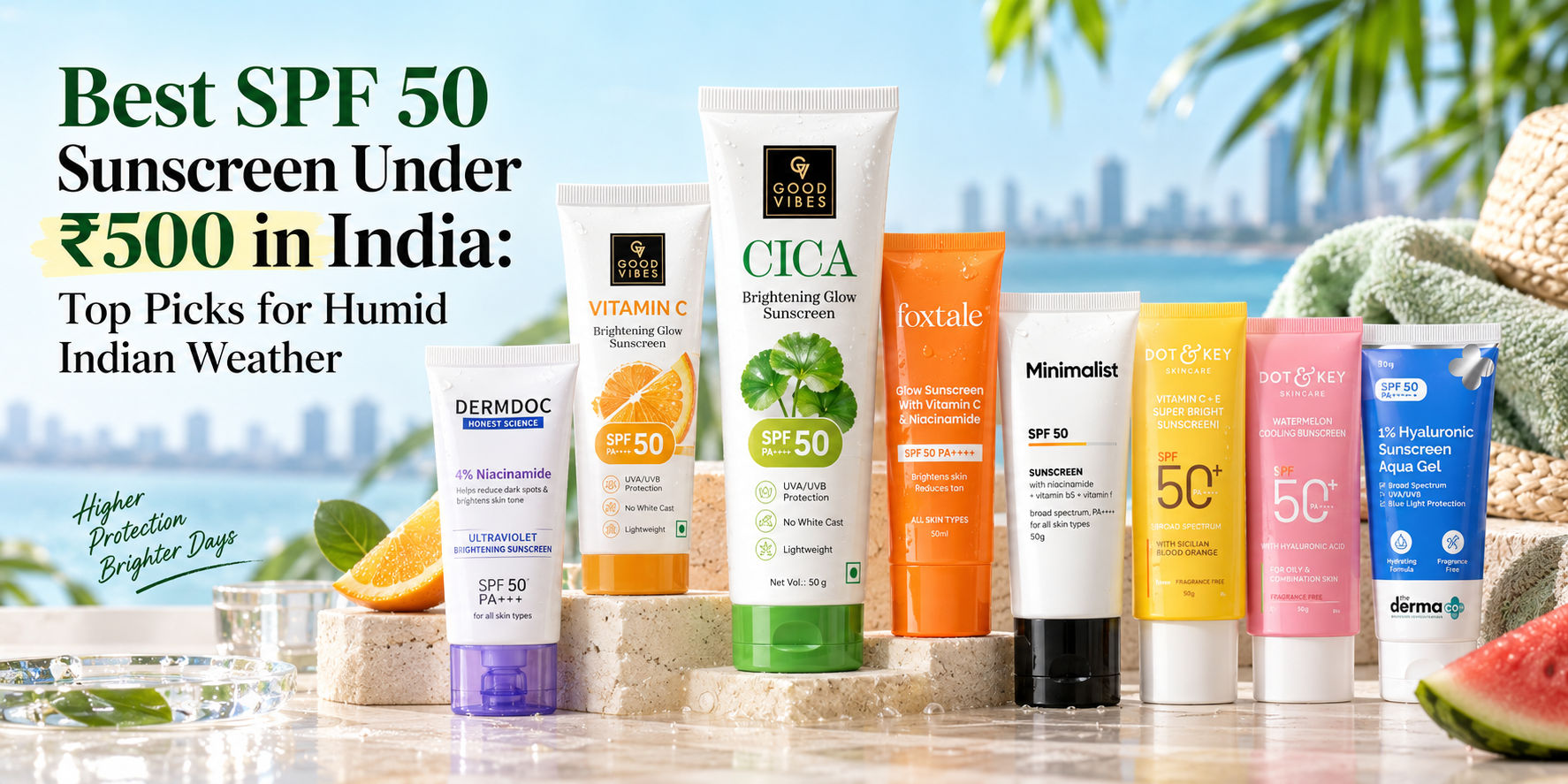
Purplle's SPF 50 shelf under ₹500 is deeper than most people expect, and the pick that holds up best through a Mumbai August is the Good Vibes CICA Brightening Glow Sunscreen SPF 50 PA++++. It's an aqua-gel that sinks in without the tacky film most high-SPF formulas leave behind in humidity, and the 3% niacinamide gives it a second job on skin dealing with post-inflammatory hyperpigmentation, which shows up readily on melanin-rich Indian skin after acne or shaving. If you want brightening as the headline instead, the Good Vibes Vitamin C SPF 50 is the budget-friendly alternative with a similar weightless finish. Skip the DERMDOC 4% Niacinamide Ultra Violet Brightening Sunscreen if you dislike tinted formulas — its purple-cast base neutralises sallowness but does behave like light makeup, which not everyone wants before a workday.
One thing worth setting straight early: SPF 50 isn't dramatically stronger than SPF 30. Research suggests the gap is a couple of percentage points of UV rays blocked, and neither buys you longer wear. You still need to reapply roughly every two hours, so a formula you actually enjoy putting on twice matters more than the number on the tube.
Key Takeaways
• Good Vibes CICA Brightening Glow Sunscreen SPF 50 PA++++ offers a lightweight aqua-gel formula that absorbs quickly without leaving any greasy residue.
• Broad-spectrum SPF 50 blocks about 98% of UVB rays, but reapplying every two hours—not the number on the bottle—determines how protected you actually stay.
• Purplle carries multiple SPF 50 sunscreens priced under ₹500, bringing effective broad-spectrum UVA and UVB protection within reach for everyday use.
• Chemical UV filters dissolve into formulas rather than sitting on skin as particles, which means no white cast, absolutely essential in humid Indian weather.
Why This Matters
An SPF 50 sounds like meaningfully more protection than an SPF 30, but the math doesn't back that up. SPF 30 already blocks about 97% of UVB rays, and even jumping all the way to SPF 100 only adds another 1-2%. What actually determines whether you're protected is reapplication: protection from any SPF typically holds for two hours or less, so a higher number won't buy you a longer stretch between applications. For most people, a broad-spectrum SPF 30 covers daily indoor-outdoor movement fine; SPF 50 earns its place if you're out for long stretches, especially if your skin burns easily.
Where Sunscreen Habits Actually Fall Apart in India
A study of sunscreen users in south India found high awareness of sun protection but real gaps in practice: people apply it only to the face, use too little product, skip reapplication, and assume sunscreen isn't needed indoors. That last one matters in a country where UVA passes through window glass and most of the year is spent in humid, high-exposure conditions. Under ₹500, the honest question isn't just SPF 50 versus 30, it's whether the formula sits comfortably enough under sweat and humidity that you'll actually reapply it, which is what the protection depends on.
How We Choose Our Products
Sunscreen under ₹500 gets judged differently in Indian humidity. We looked first at how a formula behaves once you're sweating through a July afternoon, whether it stays light, turns greasy by noon, or leaves a chalky white cast on brown skin tones. Broad-spectrum coverage, PA rating and the filter system mattered more than front-of-bottle claims. We checked verified ratings and review counts, then weighed what you're actually getting for the money.
Competitor brands sit on this list on merit. The scope here is the whole market, not just Purplle's own labels. Every pick also carries one honest limitation, because nothing in this price band does everything well.
Best SPF 50 Sunscreen Under ₹500 in India: Top Picks for Humid Indian Weather
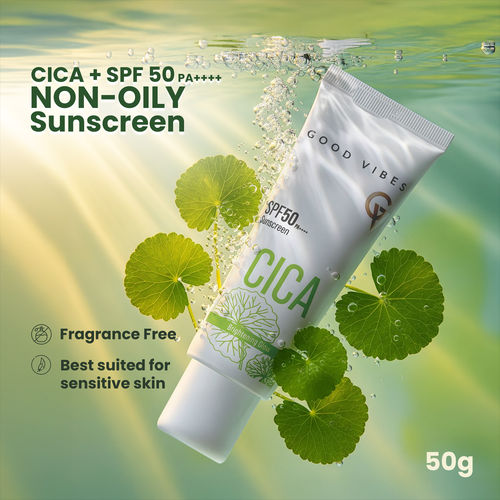
The Good Vibes CICA Brightening Glow Sunscreen SPF 50 earns the top spot for how it settles into skin during Mumbai's muggy afternoons: the aqua-gel texture sinks in fast, leaves no white cast on deeper, melanin-rich skin tones, and never gets that tacky, sweaty-forehead feel humidity usually forces onto sunscreens.
Best for: Daily humid-weather wear with a brightening angle | Format: Lightweight gel-cream that sinks in fast | Key actives: Centella asiatica (CICA), SPF 50 PA++++ broad-spectrum filters | Skip if: You want a fully matte, powdery finish
CICA is the reason this one gets picked for skin that's already irritated by heat rash or post-shave redness. The finish is soft and slightly dewy rather than flat, on oily skin in Mumbai humidity, you'll likely want blotting paper by afternoon, which is an honest trade-off, not a flaw. PA++++ matters here because UVA drives the tanning and post-inflammatory hyperpigmentation that brown skin tones hold onto longest. It spreads clear with no white cast.
Who should use it: Normal, dry, or sensitive skin that reacts to heat and wants brightening support alongside sun protection.
Who should skip it: Very oily skin that needs a shine-free matte finish through a full workday.
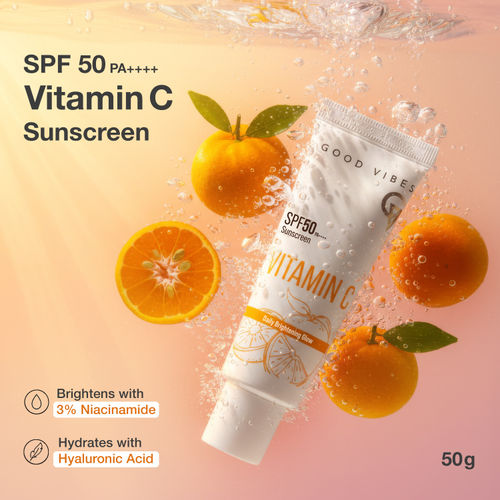
Best for: daily city sun with a brightening bonus | Format: lightweight fluid, satin finish | Key actives: vitamin C, SPF 50 PA++++ filters | Skip if: you want zero shine in peak humidity
Vitamin C alongside SPF 50 PA++++ is a sensible pairing for Indian daytime, since the PA++++ marking covers the UVA rays tied to tanning and post-inflammatory hyperpigmentation that lingers stubbornly on melanin-rich skin. It spreads thin and sinks in without the greasy weight many sunscreens leave behind, settling to a soft satin rather than a matte flatness. In Mumbai-level humidity, though, that satin can tip slightly shiny by afternoon, so blotting paper helps. Two fingers' worth is the honest amount.
Who should use it: Anyone wanting sun protection and gradual brightening in one step, especially on normal to slightly dry skin.
Who should skip it: Very oily skin chasing a dry, powdery matte finish through a long humid commute.
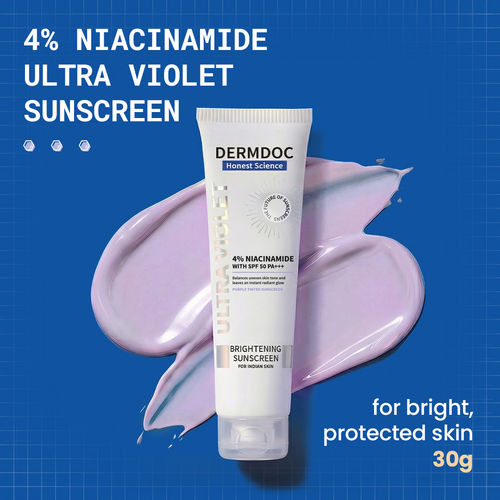
Best for: oily, humid-weather days with pigmentation concerns | Format: lightweight gel-cream, semi-matte finish | Key actives: 4% niacinamide, SPF 50 PA+++ broad-spectrum filters | Skip if: you want a dewy, glowy finish
Niacinamide at 4% is doing double duty here, and that matters if post-inflammatory hyperpigmentation from old acne is what you're actually trying to fade, sun exposure darkens those marks faster than anything else. It spreads thin and sinks in without that sticky film Mumbai humidity usually drags out of a sunscreen. The catch is the semi-matte finish, which can read slightly flat on dry skin. And 30 gm goes quickly once you're applying enough for face and neck.
Who should use it: Oily and combination skin dealing with dark marks who want sun protection and brightening in one step.
Who should skip it: Dry or dehydrated skin that needs a cushiony, moisturising sunscreen without a mattifying finish.
Best for: daily city sun with brightening support | Format: thin lotion, no white cast | Key actives: Vitamin C, niacinamide, UVA/UVB filters | Skip if: you want a mineral-only formula
Two fingers' worth spreads out fast and settles into a soft, slightly dewy finish rather than a matte one, which is worth knowing if you're oily by 2pm in Mumbai humidity. The vitamin C and niacinamide pairing may help fade the post-inflammatory hyperpigmentation that lingers on melanin-rich skin, so old acne marks get a little help while you're protected. PA++++ covers UVA well. Protection still fades in about two hours, so reapplication isn't optional.
Who should use it: Anyone with normal to slightly dry brown skin who wants sun protection and some tone-evening in one step.
Who should skip it: Very oily skin that needs a hard matte finish, or anyone whose skin reacts to vitamin C.
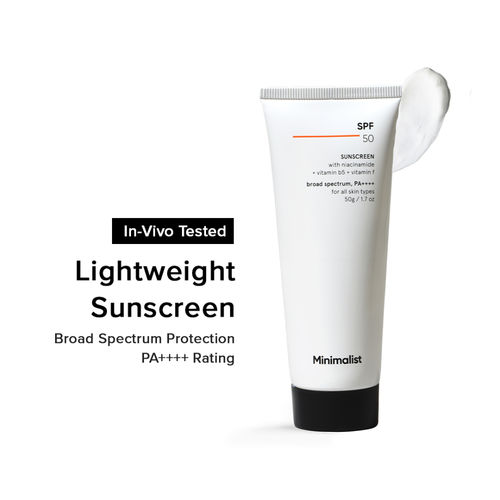
Best for: daily city sun exposure | Format: lightweight gel-cream fluid | Key actives: broad-spectrum UV filters, niacinamide, vitamin B5, vitamin F | Skip if: you want a mattifying finish for very oily skin
Blends in clear on brown skin tones without the grey cast that trips up so many mineral formulas, and it sinks in fast enough to layer makeup over within a couple of minutes. The niacinamide is a sensible addition here, since it may help calm the post-inflammatory hyperpigmentation that lingers on melanin-rich skin long after a breakout fades. The finish stays slightly dewy, though, which in Mumbai humidity can read as shine by midday. Reapplication every two hours still matters, whatever the SPF number says.
Who should use it: Anyone with normal, dry or combination skin who wants a fuss-free daily sunscreen that disappears into the skin.
Who should skip it: Very oily skin types chasing a dry matte finish will likely find this too glowy by afternoon.
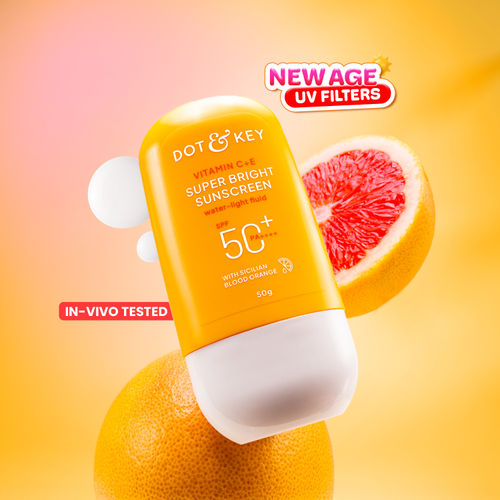
Best for: brightening alongside daily sun protection | Format: lightweight gel-cream, dewy-matte finish | Key actives: Vitamin C, Vitamin E, SPF 50+ PA++++ | Skip if: you want a bone-dry matte finish
Vitamin C and sunscreen make sense together, research suggests antioxidants support skin against daily sun exposure, which in practice means fewer new dark spots forming while you're already protecting against them. That matters on melanin-rich Indian skin, where post-inflammatory hyperpigmentation lingers for months. It spreads thin and sinks in without the white cast that trips up brown skin tones. The finish leans slightly dewy, though, so in peak Mumbai humidity you may want blotting paper by mid-afternoon.
Who should use it: Anyone tackling uneven tone and daily UV in one step, especially normal to slightly dry skin.
Who should skip it: Very oily skin that turns shiny fast, or anyone whose skin stings with vitamin C.
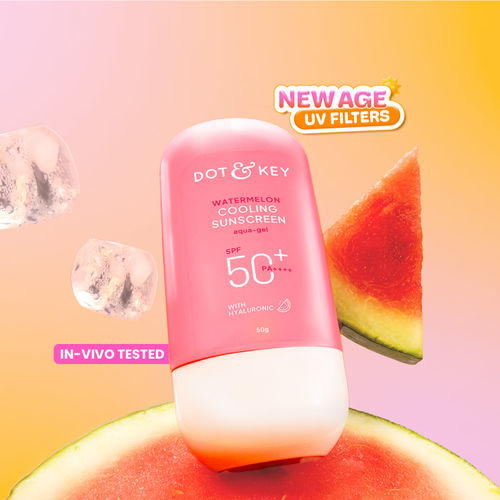
Best for: Oily, sweat-prone skin in humid weather | Format: Lightweight watery gel, matte finish | Key actives: Hybrid UV filters, watermelon extract, hyaluronic acid | Skip if: You want a dewy, glowy finish
Spread it on and there's a genuine cool-down for the first few seconds, which makes it easier to reapply at noon in Mumbai or Chennai humidity instead of skipping it. It sinks in fast, leaves no grey cast on brown skin tones, and sits quietly under makeup. The catch is longevity: on very oily skin you'll still see shine by mid-afternoon, so the two-hourly reapplication that research suggests is necessary anyway becomes non-negotiable here.
Who should use it: Anyone with oily or combination skin who commutes in heat and humidity and wants sun protection that doesn't feel like a second layer of skin.
Who should skip it: Dry or mature skin that needs cushion and glow will find this too matte on its own without a moisturiser underneath.
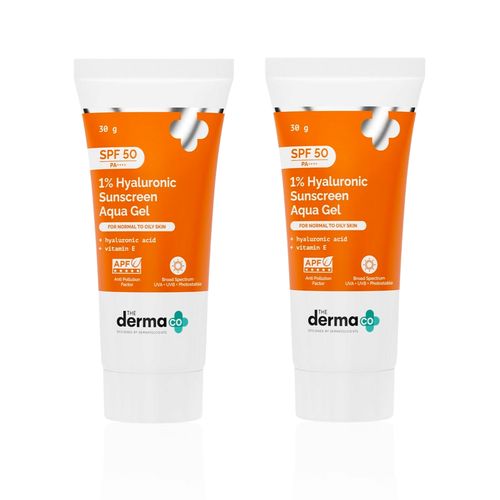
Best for: Oily, humidity-prone skin | Format: Lightweight aqua gel | Key actives: 1% hyaluronic acid, broad-spectrum SPF 50 PA++++ | Skip if: You want a mattifying finish
This one sinks in fast and stays quiet under Mumbai humidity, with a slightly slippery gel slide that dries down soft rather than tacky. The hyaluronic acid keeps things comfortable, so skin doesn't feel tight by mid-afternoon and you're less tempted to skip reapplication. Two hours is still the honest reapplication window for any sunscreen, higher SPF included. The dewy finish reads shiny on very oily skin by noon, and 30 gm goes quickly at a proper two-finger dose.
Who should use it: Anyone with oily or combination skin who wants sun protection that doesn't feel like a second layer in sticky weather.
Who should skip it: People who prefer a flat matte finish or need a single large tube rather than a two-pack.
Sunscreen shopping under ₹500 usually means trading off between a heavy white cast and a runny formula that sweats off by noon in Mumbai or Chennai's humidity. All eight picks here deliver SPF 50 without blowing the budget, but texture and finish vary enough that the wrong choice means reapplying every two hours anyway. For humid Indian weather, the Good Vibes CICA Brightening Glow Sunscreen SPF 50 PA++++ stands out as the pick worth starting with, since its cica-and-niacinamide aqua gel absorbs fast without leaving the chalky cast that thicker creams do under sweat and tan.
Apply sunscreen as the last step in your morning routine, after moisturiser and before makeup or primer, so it sits on top of skin instead of getting diluted or pushed around by other products.
Use about two finger-lengths (roughly a teaspoonful) for face and neck together, since research shows most people apply less than half the amount needed to get the SPF printed on the bottle.
Wait a full 15 minutes before stepping into the sun, because that's how long the filters need to settle and form an even film across skin.
Pair it with a hat or dupatta on peak-heat days between 11 am and 4 pm, and skip layering it under heavy, oil-based creams that can break the film and cause pilling in humidity.
If you're new to daily SPF, start with morning-only application and build up to reapplying every two hours once you're outdoors for long stretches; established users should already be reapplying that often, since protection fades regardless of the SPF number on the label.
In humid Indian cities, keep a travel-size tube in your bag rather than leaving a full bottle in a hot car or on a sunlit window ledge, since heat and moisture speed up how fast the formula separates.
One habit worth dropping: treating sunscreen as a once-a-day, indoors-included formality. Reapplication matters more than chasing a higher SPF number, and a sweat-resistant formula reapplied on time will protect you better than a high-SPF one left on for eight hours straight.
Frequently Asked Questions
Which sunscreen suits all skin types in humid Indian weather?
Minimalist SPF 50 Sunscreen works across skin types thanks to its niacinamide and vitamin B5 base, which keeps the aqua-gel texture light without clogging pores. It's a fair default when you're unsure which category you fall into.
Is SPF 50 actually necessary in Indian summers, or is SPF 30 enough?
Yes, SPF 50 earns its place here. India's UV index regularly sits in the "very high" to "extreme" range for months at a stretch, and SPF 30 already blocks around 97% of UVB rays while SPF 50 pushes that only slightly higher, the real gain is a longer margin for the under-application most people are guilty of.
What's the actual difference between chemical and physical sunscreen?
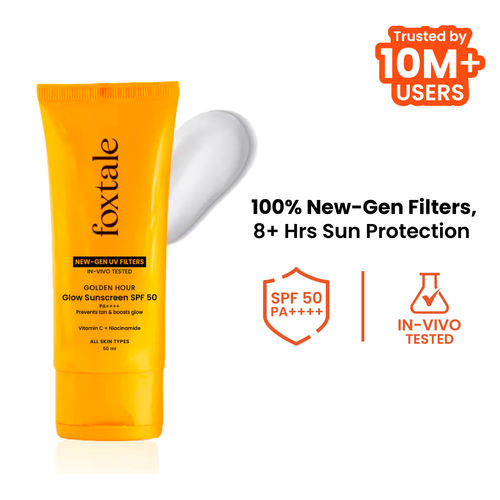
Physical (mineral) filters sit on skin and reflect UV rays, which can leave a white cast on deeper tones; chemical filters dissolve into the formula and absorb UV, staying invisible at any skin tone. Most SPF 50 gels sold here, including the Foxtale Glow Sunscreen, lean chemical for that no-cast finish.
Do I still need to reapply sunscreen if it's marketed as sweat-resistant?
Yes, sweat-resistant isn't sweat-proof. Reapply every two hours regardless of the claim, since protection windows run out on that clock for nearly all sunscreens, and humid Mumbai or Chennai afternoons will wear a layer down faster through touch and perspiration alone.
Which pick is best if I have oily, acne-prone skin?
DERMDOC 4% Niacinamide Ultra Violet Brightening Sunscreen is formulated for oily skin, with a purple-tinted finish that helps counter sallowness. The tint takes some getting used to under makeup, but the mattifying effect holds up through a humid workday.
Are the products sold on Purplle genuine?
Yes. Purplle runs an inventory-led model, sourcing directly from brands and authorised distributors rather than opening listings to unverified third-party sellers, so what reaches you matches what the brand ships.
Can applying more sunscreen than the label suggests improve protection?
Somewhat, but most people already apply far less than the recommended 2mg per square centimetre, so the practical fix is reapplying properly rather than layering on excess in one go. Under-application, not formula strength, is the more common gap in real-world sun protection in India.